For partners with different tastes, the goal is two accurate gifts, not one compromise repeated twice. A Missing You mug and a Distance Means So Little map light can form a coherent exchange when one person likes useful kitchen objects and the other likes personal displays. The shared long-distance relationship supplies the connection; each person’s preference supplies the format.
Write two small buying briefs before comparing the products. One might be “a familiar cup with our initials”; the other might be “our current cities in a meaningful object.” Those descriptions are specific enough to guide a purchase without pretending both owners want the same experience.
Brief A: useful, personal, and independent of a display
The mug owner does not have to become less practical to receive a romantic gift. Initials and the travel illustration can remain meaningful precisely because the cup is chosen for frequent use.
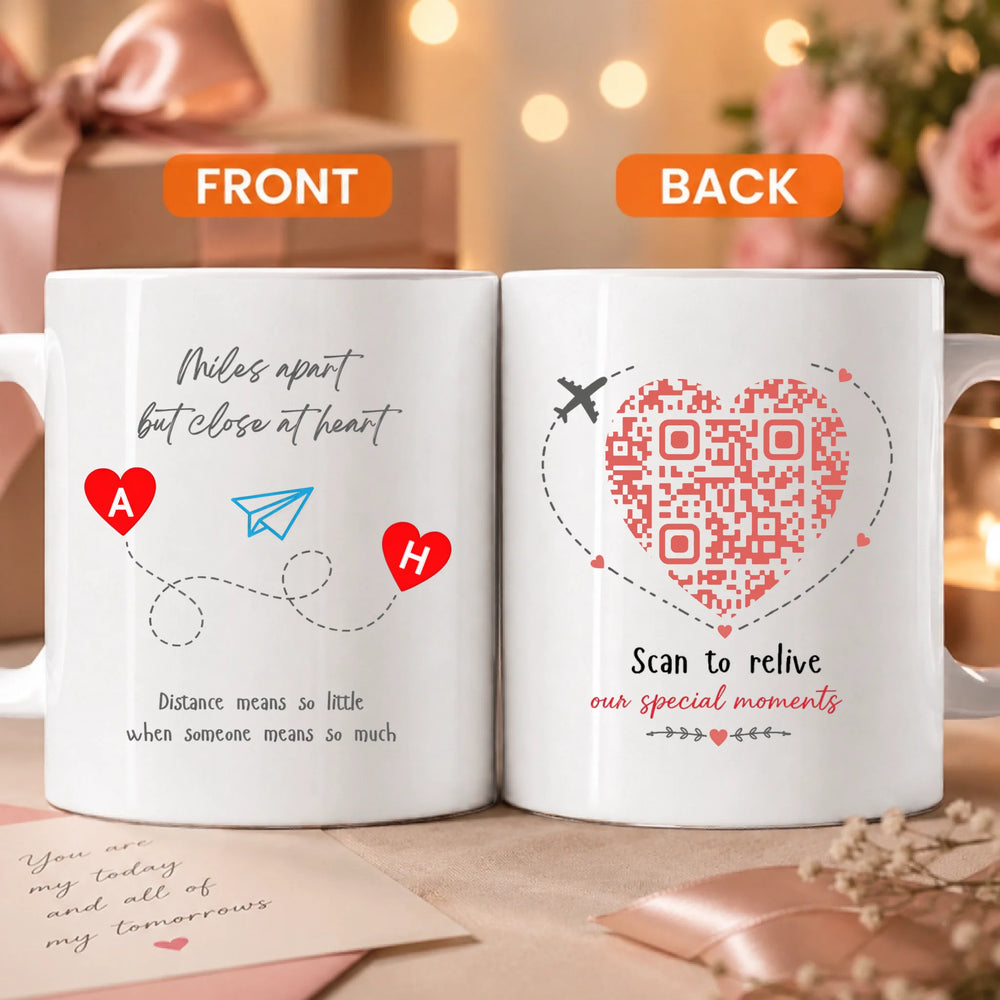
The Missing You mug uses initial hearts, a paper airplane, and a dotted travel line. The design suggests two people connected across distance without covering the mug in a large photograph. That makes it an appealing match for a partner who wants something personal but still thinks of a mug primarily as a useful kitchen object.
The initials can represent you both. They act as a small shared signature within the design, while the travel imagery supplies the long-distance context. This is especially effective for someone who likes meaning that is immediately recognizable to them without needing to explain the whole story to everyone else.
It is white ceramic, with 11 oz and 15 oz options. The retailer describes printing on both sides and says the mug is microwave and dishwasher safe. The size choice should follow the recipient's drink habits. A smaller mug can be exactly right for their usual coffee; a larger mug may suit someone who prefers a more generous serving.
Imagine the ordinary Tuesday use, not just the moment of opening. If the recipient would take it from the cupboard because it holds the drink they want and the design makes them think of you, it is doing its job. The gift does not need to be kept untouched on a shelf to qualify as a keepsake.
Personalize the Missing You mug
Brief B: two places made into a visible keepsake
The light owner is buying into a different kind of enjoyment: the satisfaction of giving personal objects a place. That preference can deserve just as much attention as the other person’s usual drink capacity.
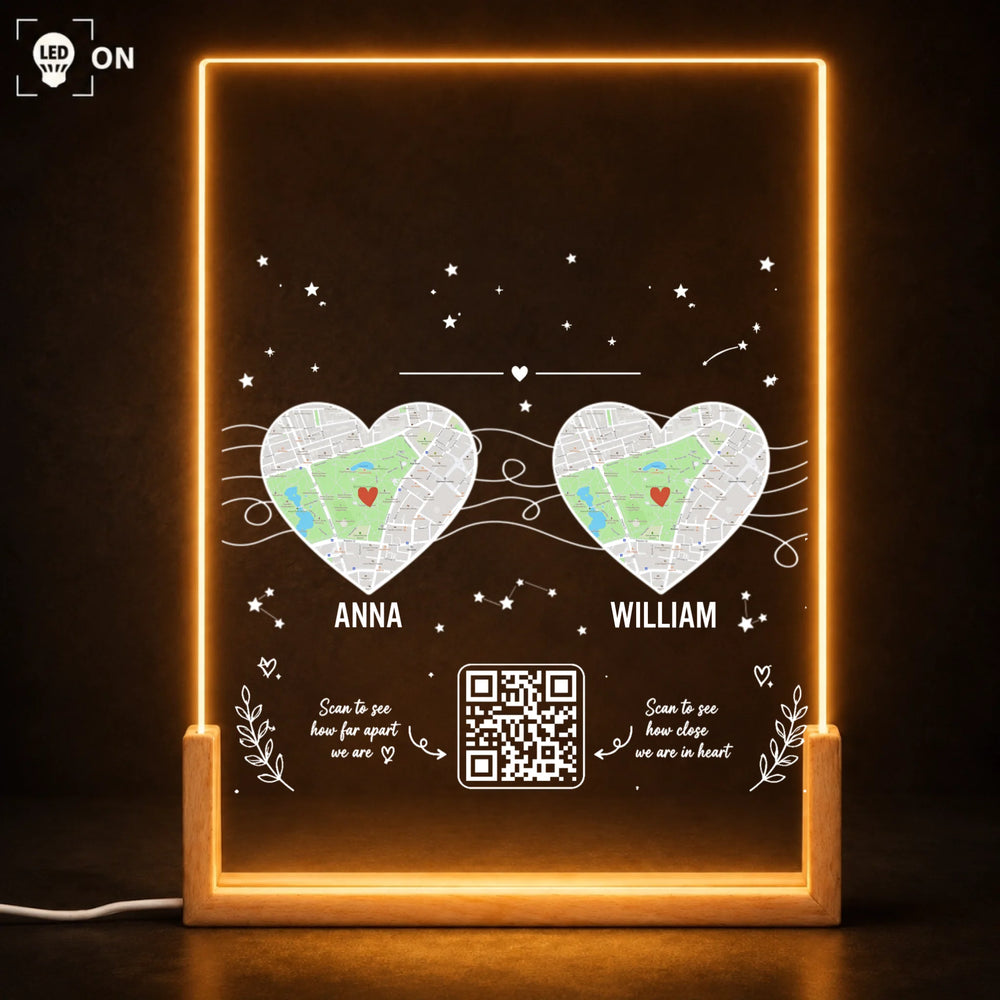
The map night light puts two heart-shaped location maps and names on an optical acrylic panel with a natural wood base. It gives the relationship a visible place in the room. Where the mug's initials suggest the two people, the light's maps give their separate locations a more explicit role.
This is a good match for the person who enjoys personal objects on a bedside table, a dresser, or a dedicated shelf. The map composition is meaningful on its own; it does not rely on the recipient having a perfect couple photograph available.
The sizes are 5 × 7 and 6 × 8 inches. Choose according to how much presence the recipient likes in that particular spot. A small arrangement beside books may suit the smaller size, while a shelf where the light is a focal object may suit the larger.
The light is USB powered, with the retailer listing 5V, 0.5A. Moonlight is the current light-color option for this design. Its practical requirement is a convenient power connection where the recipient wants to see it. Its purpose is decorative atmosphere and personal meaning, rather than reading illumination.
Use the two locations that make sense in your shared story. Current cities can give the pairing a particularly clear logic: the mug travels through one person's day, while the map light places both cities in the other person's room. You do not have to match every piece of text to make the objects feel related.
What belongs in both briefs
Keep the same relationship at the center while allowing different visible details. The initials on a mug do not need to duplicate the full names on a light. Both can refer to the same people without matching character for character.
Matching sometimes means identical colors and shapes. For a couple with different tastes, that can be the least helpful definition. A better one is that both gifts reflect the same people while fitting the individual who will live with each object.
Think about how you each show affection in your homes. One person may use a favorite mug until it becomes part of the breakfast routine. The other may carefully choose which objects sit beside the bed. Neither habit is more sentimental. They simply give a keepsake a different role.
Your buying decision should preserve those differences. Choose a cup because its owner likes using cups, and a light because its owner likes decorative lights. Then connect the designs through the relationship details rather than making one person accept the other's preferred format.
Avoid assigning the supposedly “practical” gift to the person who seems less emotional. A coffee ritual can carry enormous personal meaning. Equally, a decorative gift is useful in a different sense when the recipient genuinely enjoys making a room feel like their own. Start with observed habits instead of personality stereotypes.
What does not have to match
Before buying a second object, distinguish a mutual exchange from a gift for your partner. A one-person purchase is complete when that person has been considered well.
You can connect the gifts through the same occasion, a shared card, or opening them during a call. They do not need the same size, the same visual density, or a forced matching slogan. Their job is to belong comfortably in two separate lives.
It is also reasonable to buy only one at first. If you are choosing for your partner rather than arranging a mutual exchange, select the product that fits them. There is no need to buy a second item merely to complete an idea of a couple set.
If both people like coffee but only one likes visible room decor, two independently selected mugs may be the more natural pair. If both love small displays and have suitable powered spaces, map lights may appeal to both. The recommendation for different formats applies when the preferences genuinely differ.
Your purchase direction
Buy the mixed pair only when both briefs are true. The successful match is between each person and their own gift; the couple theme should support that fit rather than override it.